The terms “AI agent” and “chatbot” are often used interchangeably, but in 2026 they describe fundamentally different technologies. As businesses race to automate customer interactions, internal workflows, and hiring processes, understanding the distinction is no longer optional — it’s a strategic necessity. A chatbot answers questions; an AI agent gets things done. That single sentence captures the most important shift in conversational AI over the past two years. According to Gartner’s 2026 forecast, 40% of enterprise applications will feature agentic AI capabilities by 2027, up from less than 5% in 2024. This article breaks down exactly what separates these two technologies, when to use each, and how platforms like EasyHire AI are blending both to reshape industries like recruiting.
What Is a Chatbot?
A chatbot is a software application designed to simulate human conversation through text or voice interactions. Chatbots operate on a spectrum of complexity:
- Rule-based chatbots follow decision trees. They match keywords or intents to predefined responses. Think of a restaurant bot that answers “What are your hours?” with a fixed reply.
- AI-powered chatbots use natural language processing (NLP) and large language models (LLMs) to understand context and generate dynamic responses. These can handle more varied inputs but are still fundamentally reactive.
Chatbots excel at handling high-volume, repetitive interactions. A 2025 Juniper Research study found that chatbots saved businesses over $11 billion annually in customer service costs. They are widely deployed in e-commerce, banking, and SaaS support.
However, chatbots have clear limitations:
- They respond to inputs but rarely initiate actions.
- They lack the ability to use external tools or APIs autonomously.
- They struggle with multi-step reasoning or tasks that require decision-making across systems.
- When a conversation falls outside their training or rules, they either hallucinate or hand off to a human.
In short, chatbots are conversational interfaces — powerful for dialogue, but limited when real-world action is required.
What Is an AI Agent?
An AI agent is an autonomous system capable of perceiving its environment, reasoning about goals, planning a sequence of actions, and executing those actions using external tools and APIs — all without step-by-step human instruction.
The architecture of a modern AI agent typically includes:
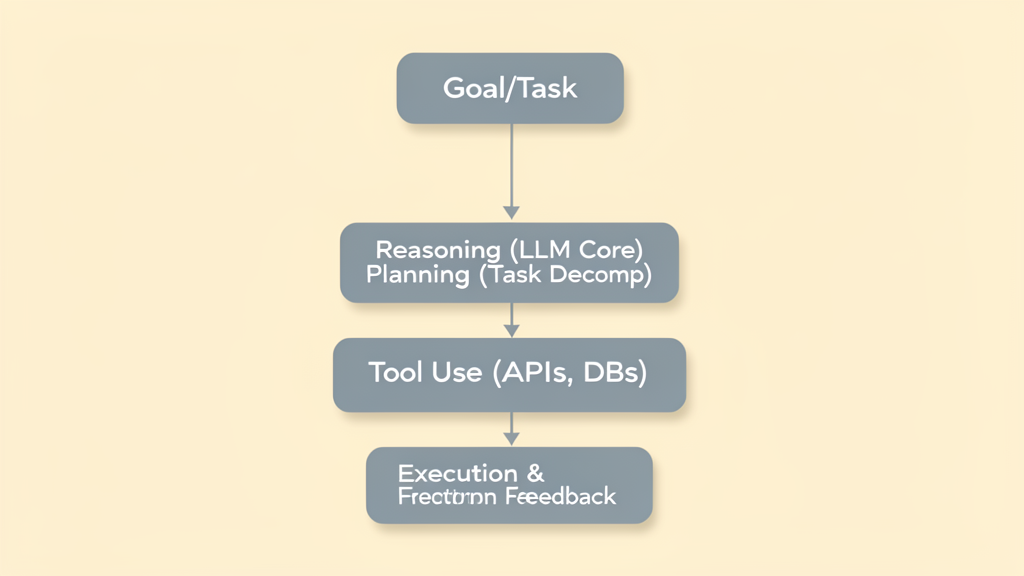
Unlike chatbots, AI agents can:
- Break complex goals into sub-tasks and execute them in sequence.
- Call external tools such as databases, calendars, CRMs, and search engines.
- Maintain memory across sessions, learning from past interactions.
- Recover from errors by replanning or trying alternative approaches.
- Operate asynchronously over long time horizons (hours or days).
The agentic AI market is projected to reach $65 billion by 2028, according to MarketsandMarkets. Companies like OpenAI, Anthropic, and Google are investing heavily in agent frameworks, and enterprise adoption is accelerating across healthcare, finance, and human resources.
AI Agent vs Chatbot: Side-by-Side Comparison
Understanding the difference requires looking at specific capabilities. Here’s how the two technologies compare across key dimensions:
| Dimension | Chatbot | AI Agent |
|---|---|---|
| Primary function | Answer questions and handle conversations | Achieve goals through autonomous action |
| Architecture | NLP/LLM + response generation | LLM + reasoning + planning + tool use |
| Autonomy | Reactive — waits for user input | Proactive — can initiate and follow through |
| Tool use | Limited or none | Extensive — APIs, databases, external systems |
| Memory | Session-based or stateless | Persistent across sessions and tasks |
| Error handling | Falls back to human handoff | Replans, retries, or escalates strategically |
| Complexity of tasks | Single-turn or short multi-turn | Multi-step, multi-system workflows |
| Cost to build | Lower — simpler infrastructure | Higher — requires orchestration and guardrails |
The key takeaway: chatbots are optimized for conversation, while agents are optimized for completion. A chatbot tells you your flight status; an agent rebooks your flight, notifies your hotel, and updates your calendar.
When to Use a Chatbot vs an AI Agent
Choosing between a chatbot and an AI agent depends on the complexity of the task and the level of autonomy required.
Use a chatbot when:
- You need to answer frequently asked questions at scale.
- The interaction follows a predictable, linear flow.
- Cost efficiency is the top priority.
- You need a fast time-to-deploy solution.
Use an AI agent when:
- Tasks involve multiple steps across different systems.
- The workflow requires decision-making, not just information retrieval.
- You need the system to take action, not just provide answers.
- Long-running processes need to be managed autonomously.
For example, in recruiting, a chatbot might answer a candidate’s question about company benefits. An AI agent, by contrast, could screen 200 resumes against job requirements, shortlist the top 10 candidates, schedule interviews across multiple calendars, and send personalized follow-up emails — all without human intervention. This is precisely where platforms like EasyHire AI demonstrate the power of agentic systems.
How EasyHire AI Bridges Both Worlds
EasyHire AI’s Recruiting Agent OS is a compelling example of a platform that combines chatbot and agent capabilities into a unified workflow. Rather than forcing businesses to choose between conversational AI and autonomous action, EasyHire AI integrates both seamlessly.
Here’s how it works in practice:
Conversational layer (chatbot): EasyHire AI engages candidates through natural, human-like conversations. It answers questions about the role, company culture, and application process — providing the responsive, always-available experience candidates expect.
Agentic layer (AI agent): Behind the scenes, EasyHire AI’s agent autonomously parses resumes, evaluates candidate fit against configurable criteria, ranks applicants, and coordinates interview scheduling with hiring managers. These actions happen without manual intervention.
Orchestration: The Recruiting Agent OS connects to your existing ATS, calendar, email, and communication tools, executing end-to-end hiring workflows that would otherwise require hours of recruiter time.
The result? Companies using EasyHire AI report a 70% reduction in time-to-hire and a 3x improvement in recruiter productivity. By blending the approachability of chatbots with the power of agents, EasyHire AI delivers measurable outcomes, not just conversations.
Choosing the Right Technology for Your Business
When evaluating chatbot and AI agent solutions, consider these criteria:
- Task complexity. Can the work be done in a single response, or does it require multi-step orchestration?
- Integration depth. Does the solution need to connect with external tools and data sources?
- Autonomy requirements. Should the system act on its own, or only respond when prompted?
- Scalability. Will the workload grow, and can the solution handle increasing complexity?
- Compliance and guardrails. Does the solution offer human-in-the-loop controls where needed?
- Time to value. How quickly can the solution be deployed and deliver ROI?
EasyHire AI meets all six of these criteria. Its Recruiting Agent OS offers configurable autonomy levels, deep integrations with major ATS platforms, SOC 2 compliance, and a setup process that takes minutes, not months. Whether you’re a startup hiring your first engineer or an enterprise scaling a global team, EasyHire AI adapts to your needs.
The Future: Agents That Chat
The line between chatbots and AI agents is blurring — and that’s a good thing. The most effective systems in 2026 are those that combine natural conversational interfaces with deep agentic capabilities. You talk to it like a colleague, and it works like a team.
Three trends are shaping this convergence:
- Agentic chatbots are emerging as the default enterprise interface. Gartner predicts that by 2028, 33% of enterprise software will include agentic features, up from less than 1% in 2024.
- Multi-agent collaboration allows specialized agents to work together — one handles screening, another handles scheduling, a third handles reporting — orchestrated through a single conversational front-end.
- Personalized agents that remember preferences, learn from feedback, and adapt their behavior over time are becoming the expectation, not the exception.
The future isn’t chatbot or agent. It’s both, working in concert. And platforms like EasyHire AI, with its Recruiting Agent OS, are already proving what that future looks like in practice.
Ready to see what an AI recruiting agent can do for your team?
Start your free trial → | Watch a 2-min demo →